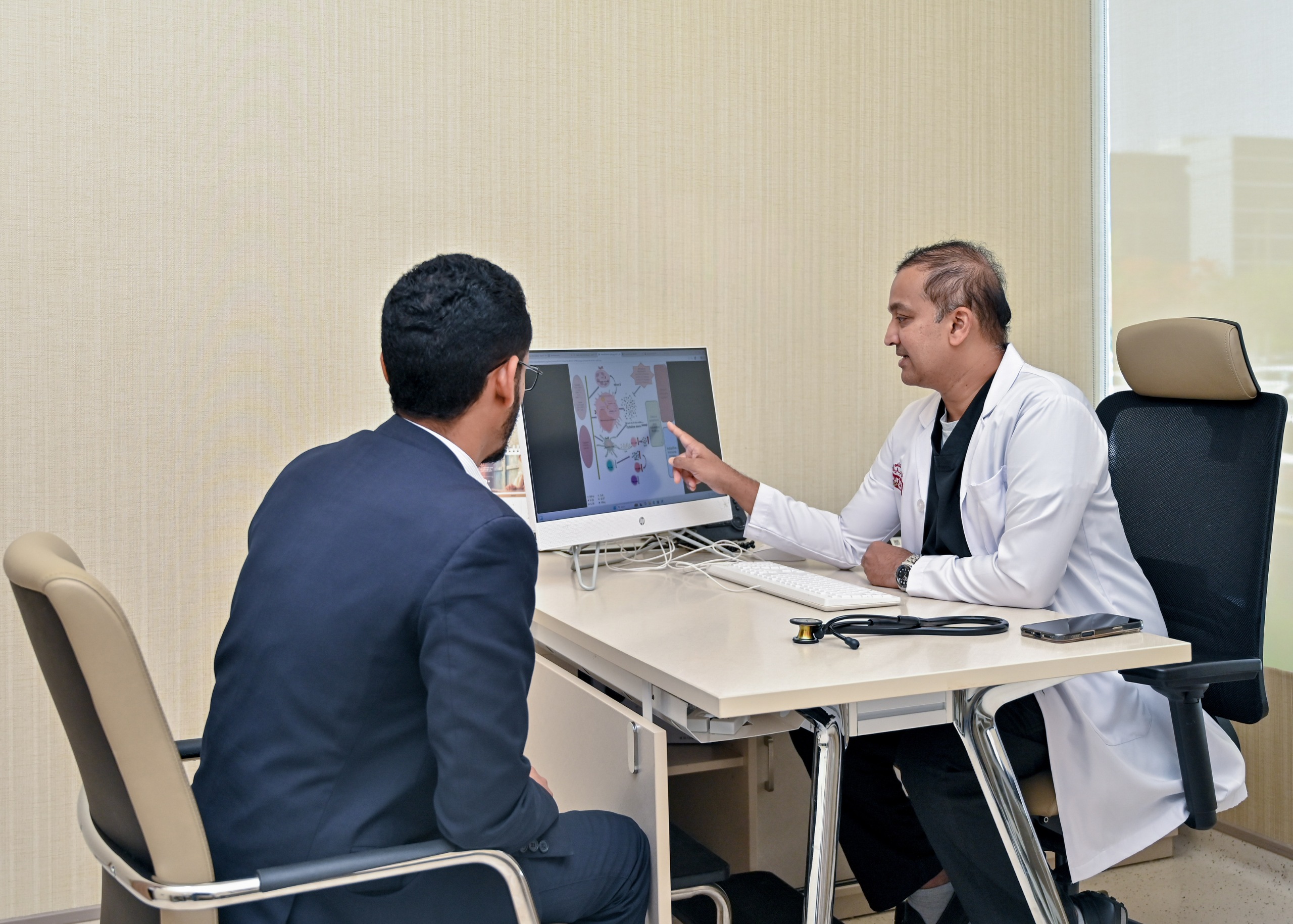
The patient, treated at Burjeel Hospital, Abu Dhabi, suffered from Adult-Onset Still’s Disease (AOSD), a rare autoimmune condition affecting approximately 1–4 people per million worldwide
Abu Dhabi: The 34-year-old patient residing in Abu Dhabi had always enjoyed robust health. So, when persistent high-grade fever plagued him for more than two weeks, it was deeply unsettling for him. Despite multiple hospital visits and extensive routine testing, including blood cultures and standard infection screens, the cause of his illness remained unknown, intensifying worries as his condition continued to worsen. With fever, disabling joint pain, extreme fatigue, and evidence of intense inflammation, and liver involvement, his condition started to raise concern as he began to show signs of a potentially life-threatening illness.
Although he looked stable, the severity and persistence of his symptoms were alarming, prompting the medical team at Burjeel Hospital, Abu Dhabi, to intervene urgently. An in-depth investigation revealed that he was affected by Adult-Onset Still’s Disease (AOSD), a rare autoimmune condition affecting approximately 1–4 people per million worldwide.
A Difficult-to-Diagnose Disorder
Dr. Niyas Khalid, Specialist, Internal Medicine, says AOSD is extremely difficult to diagnose because of its rarity and resemblance to other infections. “It mimics many life-threatening diseases such as severe infections, autoimmune disorders, liver disease, and even cancer. It’s often under-recognized, particularly in regions where fever is commonly attributed to infectious causes,” says Dr. Niyas, who treated the patient along with Dr. Abdul Hakeem Muhammed, Specialist, Internal Medicine.
At the hospital, the patient underwent a series of tests to rule out other possibilities. A major challenge was his body not having rashes, a feature often described in textbooks, but frequently absent or difficult to detect in individuals with darker complexion, adds the doctor.
In his case, what stood out was the unique combination of prolonged fever, severe inflammation, liver involvement, and extremely high ferritin levels. In addition, all infectious and autoimmune tests had returned negative. “The extraordinarily elevated ferritin, a marker of inflammation, acted as a critical diagnostic signal. When these features came together, along with high-grade fever spiking every day at regular intervals, AOSD became the most plausible explanation, although it is extremely rare,” says Dr. Niyas.
Fatal if Not Diagnosed in Time
When affected by AOSD, the patient’s immune system becomes overactive and attacks itself, causing widespread inflammation. If not diagnosed and treated at the right time, the disease can progress to severe complications such as organ damage, chronic inflammatory arthritis, liver failure, or a potentially fatal immune storm known as macrophage activation syndrome. In this case, early intervention was life-altering and, potentially, life-saving.
“During those days, I shivered from fever and struggled to get up from bed, lift my hands, and move my body. There was no appetite because of throat pain. Despite taking medicine, my fever recurred, draining me emotionally. I prayed to God to give my routine life back,” recalls the patient.
Rapid Return to Normalcy
Once AOSD was suspected, the medical team initiated high-dose corticosteroid therapy, the cornerstone treatment for this condition. After the initial high doses, the steroid was tapered carefully over several weeks to suppress the immune reaction while allowing safe recovery. “Within 24 hours, the fever subsided. Within 48 hours, the patient felt significantly better, with improvement in joint pain and energy levels. Laboratory markers improved in parallel,” explains Dr. Niyas.
“I am so happy that I can move my body without support for the first time after a while. Everyone in the hospital gave me hope whenever I doubted, got frustrated, and questioned myself,” says the patient.
Although he has recovered remarkably well, ongoing follow-up is essential as AOSD can recur in some patients. He will continue regular follow-up with internal medicine and rheumatology to monitor any signs of relapse and ensure long-term stability.